Bone Graft Materials Compared
Your own bone, donor bone, bovine mineral or a laboratory-made substitute — four graft families that behave four different ways in the jaw, compared on the 2026 reviews and on what Dallas practices tell their own patients.
Get an exact price for your implants.
A few quick questions, and one local practice sends you a written quote.
Five quick questions. Your answers go to one implant practice in your area — and your estimate comes back as an exact written quote from that practice, not a made-up range.
How this works
- Answer five questions — they tell the practice whether you need one implant or a full arch before anyone picks up a phone.
- One local practice gets your request. Not a marketplace, not a bidding list — one practice in your area.
- You get an exact written quote at a free consultation — implant, abutment, crown and fees in writing, before you decide anything.
Why no instant price?
Calculator sites invent a range from your clicks. We don't. The same mouth can price thousands apart depending on bone, extractions and the teeth you choose — so your estimate is a real quote from the practice that will do the work, with a 3D scan behind it. That is the number you can actually plan on.
Free · No obligation · We never sell your information. Your request goes to one local implant practice only.
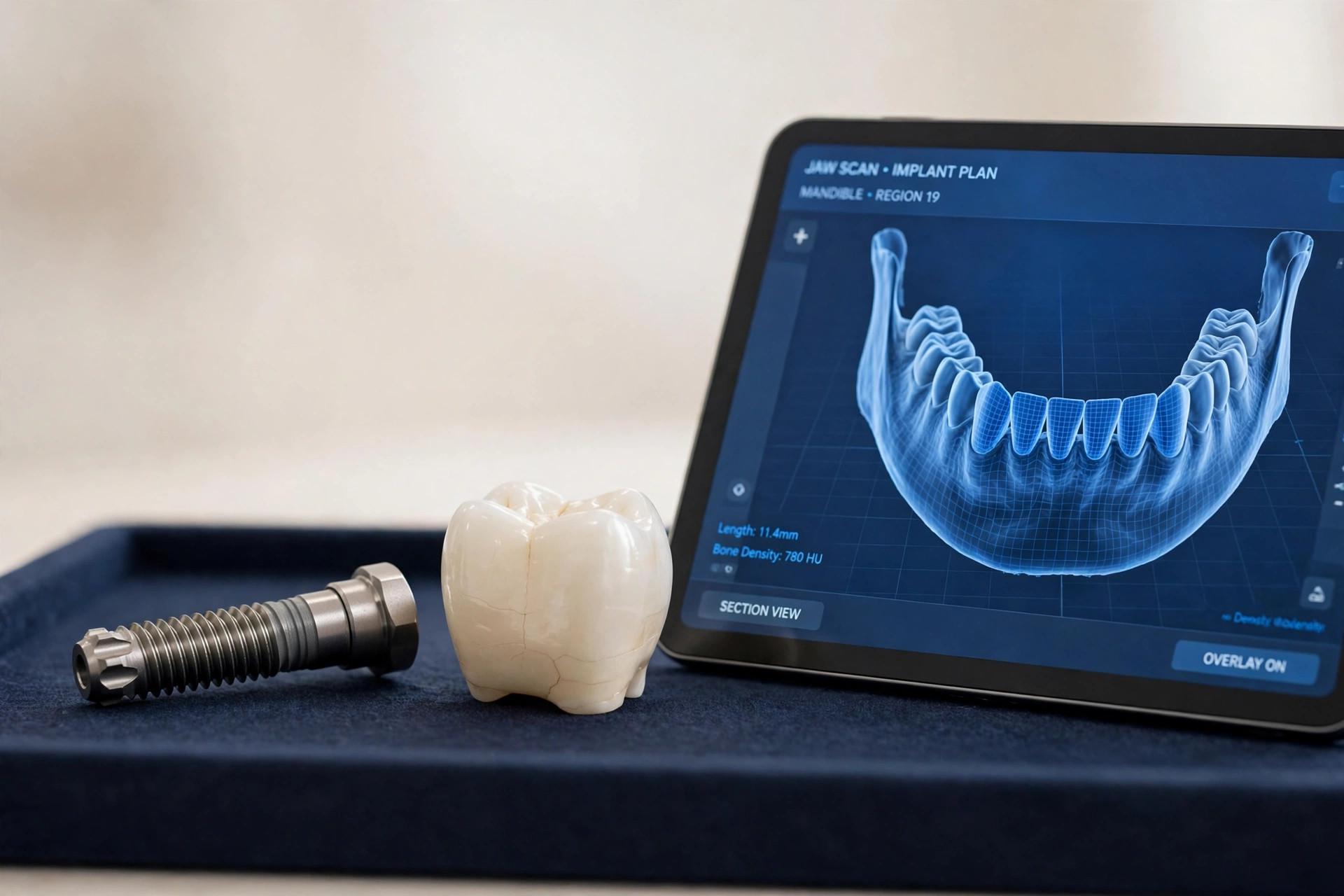
When a Dallas–Fort Worth implant plan includes a bone graft, the quote names a material most patients have never heard of — autograft, allograft, xenograft, or a synthetic — and the choice changes the surgery, the healing and sometimes the price. The materials are not interchangeable brands of the same product; they come from different sources and behave differently in the jaw. This guide compares the four families the way the 2026 review literature compares them, with the descriptions Dallas practices themselves give their patients.
The three properties every graft is judged on
Reviewers score graft materials against a triad. Osteogenesis means the graft itself contains living cells that make new bone. Osteoinduction means it carries signals that recruit the body's cells and persuade them to become bone-forming cells. Osteoconduction means it works as a scaffold — a framework the patient's own bone grows into and along. No off-the-shelf material scores on all three; that single fact explains the whole comparison that follows.
Autograft: the patient's own bone
An autograft moves bone from one place in the patient's body to the graft site — commonly from elsewhere in the jaw, and for larger needs from the chin, hip or skull. It is the only graft family with living cells, and a 2026 narrative review of bone substitutes in ridge augmentation (Journal of Functional Biomaterials) states the consensus plainly: autogenous bone remains the reference standard because it alone combines osteogenic, osteoinductive and osteoconductive potential. A Dallas oral surgery practice's patient page describes the same advantage in patient language: the graft material is live bone, containing living cellular elements that enhance bone growth.
The costs of that advantage are surgical. Harvesting bone means a second procedure and a second healing site, the amount available is limited, and — the point the 2026 Journal of Periodontal Research review stresses — the patient's own bone can resorb quickly and unpredictably once grafted. The material with the best biology is not always the material that best holds the shape of a rebuilt ridge, which is why it is so often blended rather than used alone.
Allograft: processed donor bone
An allograft is human bone from a screened donor, supplied through a tissue bank and processed — the Dallas practice page describes the freeze-dry method used to extract water under vacuum. Processing removes the living cells, so an allograft cannot produce new bone on its own; what it provides is a reliable osteoconductive scaffold. The Journal of Periodontal Research review credits processed allografts with reliable osteoconduction and volumetric stability, with reduced inductive potential compared with the patient's own bone.
The practical advantages are availability and surgery avoided: no harvest site, and material available in quantities a jaw harvest cannot match. Demineralized forms of allograft (you may see DFDBA or demineralized bone matrix on a treatment plan) are processed to expose more of the bone's signalling proteins. Donor origin matters to some patients on personal or religious grounds; if it matters to you, it is a fair question to raise before the material is chosen, not after.
Xenograft: animal-derived mineral framework
A xenograft is bone from another species, usually bovine, processed at very high temperatures to remove its organic components and leave the mineral structure — the Dallas practice description again. What remains is a scaffold with no living cells and no inductive signals, and one standout property: it resorbs very slowly. The Periodontal Research review groups xenografts with allografts for reliable osteoconduction and volumetric stability, and slow turnover is precisely why xenograft material is favoured where holding volume is the job — sinus lifts and ridge contour among them.
The trade is time and permanence of the scaffold: because the material turns over slowly, some of it remains integrated in the site long-term rather than being fully replaced by the patient's bone. The published record treats that as acceptable in the indications where xenografts are used, and patients who prefer no animal-derived material should say so — synthetic alternatives exist for most of the same jobs.
Alloplasts: synthetic materials
Alloplasts are laboratory-made: beta-tricalcium phosphate, hydroxyapatite, bioactive glass and related calcium-phosphate materials. They contain no human or animal tissue, supply is unlimited, and composition can be manufactured to order. They have no inherent biological activity — no living cells, no inductive signals — but the 2026 Periodontal Research review finds modern alloplasts achieve outcomes comparable to natural grafts in selected indications, particularly for space maintenance, such as preserving a socket after an extraction.
Why blends are the common answer
Read the two 2026 reviews together and a pattern emerges: the field's working answer for larger defects is a composite. The Periodontal Research review describes blends of a small fraction of the patient's own bone chips with a slowly resorbing xenograft or alloplast, protected by a membrane or mesh, enhancing contour stability in sinus floor elevation and in lateral and vertical ridge augmentation. The logic is direct — the own-bone fraction brings the biology, the slow fraction holds the volume, and the membrane keeps the graft where it was placed while bone grows in.
The same review describes bone substitute materials as the standard for socket preservation — the small graft placed in an extraction socket to limit ridge shrinkage — while noting their added benefit in reconstructive surgery around infected implants remains limited. And the ridge-augmentation review's closing line is the one to carry into any consultation: no single material is universally ideal, and appropriate selection for the specific defect is the skill being paid for.
The bottom line for a DFW implant plan
Ask three questions when a graft appears on your plan. What material, and why this one for this defect? Is it blended, and with what? And what healing window does this material mean before the implant is placed — in writing, on the timeline you are given. The material name on a quote is not a quality grade; autograft is not automatically the premium choice and synthetic is not the budget shortcut. Each family wins on a different property, and the right answer is the one matched to the size and shape of the bone you need to rebuild.
Sources pulled November 2026: Haugen et al., Bone Grafts: Everything You Need to Know, Journal of Periodontal Research 2026 (PMID 41711003); Bone Substitutes in Alveolar Ridge Augmentation: A Narrative Literature Review, Journal of Functional Biomaterials 2026; a Dallas oral surgery practice's published bone-grafting patient-education page (autograft, allograft and xenograft descriptions, Park Central Drive, Dallas); published DFW grafting price guidance compiled in this site's Dallas–Fort Worth bone grafting guide. This page is general information about published research and practice guidance, not a recommendation for an individual case.
Common questions
Which bone graft material is the best for dental implants?
The reviews do not name one. A 2026 narrative review of bone substitutes in ridge augmentation concludes that autogenous bone (the patient's own) remains the reference standard for combining all three bone-forming properties, that its limits drove the development of every alternative, and that no single material is universally ideal — selection follows the defect. A 2026 Journal of Periodontal Research review reaches the matching conclusion from the other side: composites that blend a small amount of the patient's own bone chips with a slow-resorbing material are the strategy the evidence keeps returning to for larger reconstructions.
What is the difference between autograft, allograft and xenograft?
The source. An autograft is the patient's own bone, moved from one site (often elsewhere in the jaw) to the graft site. An allograft is human donor bone from a tissue bank, processed and freeze-dried. A xenograft is bone from another species — usually bovine (cow) — processed to its mineral framework. A fourth family, alloplasts, is synthetic: laboratory-made materials such as beta-tricalcium phosphate, hydroxyapatite and bioactive glass. A Dallas oral surgery practice's patient-education page describes the first three the same way and notes that allograft and xenograft avoid a second procedure to harvest the patient's own bone.
Does the graft material change how long treatment takes?
It is one of the factors. Graft materials are replaced by the patient's own bone at different speeds — the patient's own bone remodels fastest but can shrink unpredictably, while xenograft material resorbs slowly and holds volume for a long time, which is why blends are common. The healing window before an implant can be placed also depends on the size and type of graft; our staged-timeline guide puts the range at roughly 3–4 months for socket preservation up to 6–9 months for large sinus lifts. Your surgical team's written timeline for your graft is the version to plan around.
How much does bone grafting add to an implant quote in Dallas–Fort Worth?
Published DFW guidance puts bone grafting at roughly $300–$3,000 depending on the volume of graft needed — the range our DFW bone grafting guide compiled from local practice pricing. Small socket-preservation grafts sit at the low end; large ridge reconstructions and sinus lifts at the high end. The material itself is rarely the whole line: membrane coverage, the surgical time and the added healing visits are priced into the same figure, which is why the graft belongs itemized in the written quote rather than estimated from the material name.
Skip the guessing. Get the exact number.
Five questions, one local practice, one exact written quote — implant, abutment, crown and fees, in writing, at a free consultation.
Reveal My Estimate →