How Much Do Dental Implants Cost in 2026?
The full US price picture — single teeth, bridges, snap-on dentures and fixed full arches — from published provider pricing, with the add-ons that move a quote and the market differences that can save you five figures.
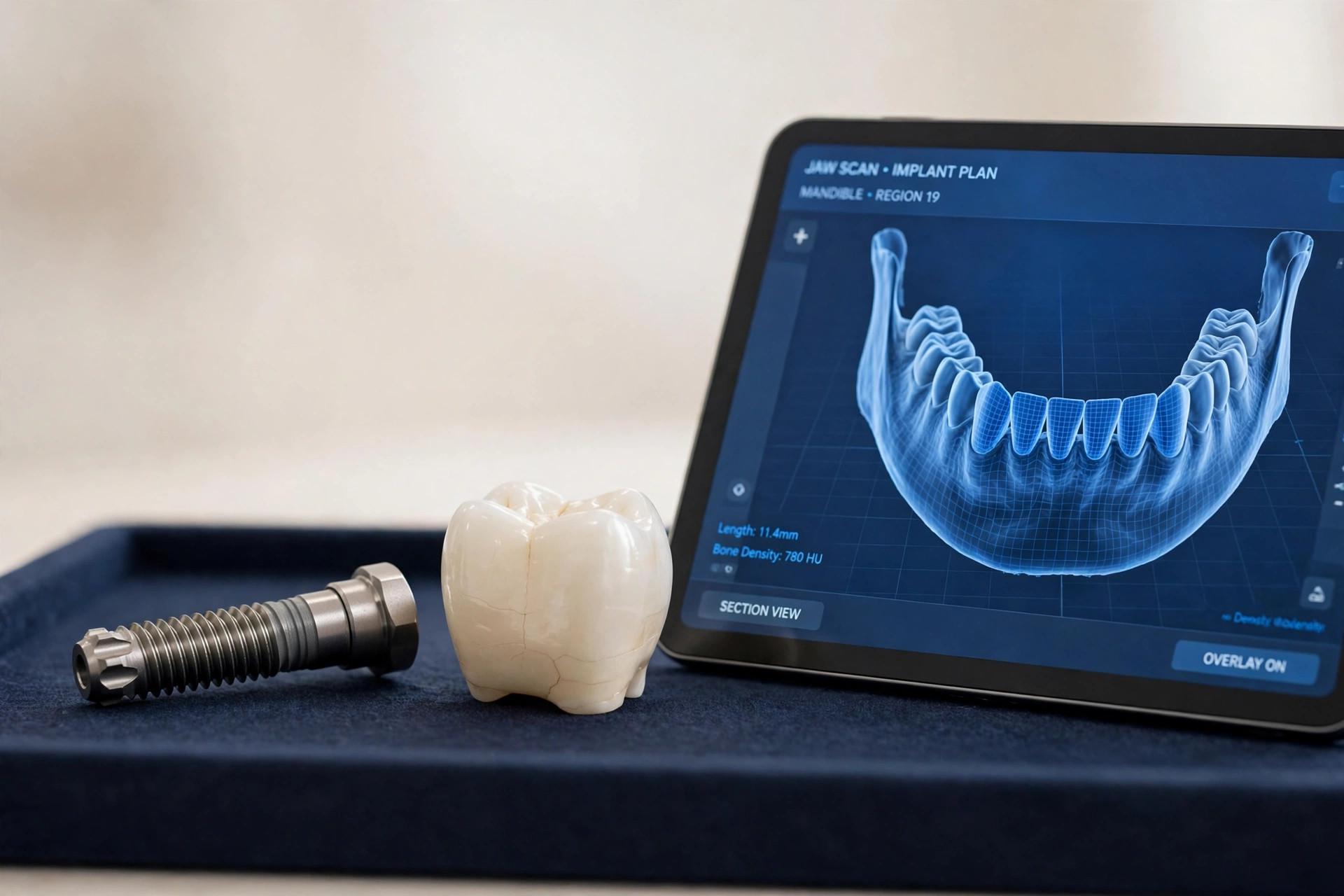
“How much do dental implants cost?” is one of the most-searched questions in dentistry — and one of the worst-answered, because the honest answer is a set of ranges with reasons attached. This guide gives you those ranges from published provider pricing, explains exactly what moves a quote up or down, and shows how to convert any range into the only number that matters: an exact written quote for your mouth.
The 2026 national price table
| Treatment | Typical US price | Notes |
|---|---|---|
| Single implant, complete (fixture + abutment + crown) | $3,000–$6,000 | Published single-tooth figures at national full-arch chains run $5,000–$7,500; competitive metros publish from ~$1,800. |
| Two implants + bridge (3–4 teeth) | $6,000–$16,000 | One span of teeth on two posts — cheaper per tooth than singles. |
| Snap-on implant denture, per arch | $8,000–$18,000 | 2–4 implants; denture clips in and out. |
| Fixed full arch (All-on-4 style), per arch | $12,000–$36,000 | Low end = high-volume regional practices; high end = national chain published range. |
| Both arches, fixed | $28,000–$60,000+ | Full-mouth specials in competitive metros advertise from ~$19,000 with conditions. |
| Consultation + 3D CBCT scan | $0–$300 | Free at most implant-focused practices. |
What you’re actually paying for
An implant quote is a bundle of five things: the fixture (the titanium post, a manufactured medical device with real cost differences between premium Swiss/US brands and value brands), the surgery (the surgeon’s time and skill — the component you least want discounted), the abutment and crown (custom lab work), the imaging and planning (3D scan, surgical guide), and the practice’s overhead and warranty. When a quote seems impossibly cheap, one of these five has been shrunk — usually the warranty or the crown material. Ask which.
The add-ons that move quotes
- Extractions — $150–$400 per tooth; a full arch of failing teeth adds up, though many full-arch quotes bundle them.
- Bone grafting — $300 for a small socket graft to $3,000+ for larger reconstruction. Bone shrinks after tooth loss, so waiting raises the odds you’ll need this.
- Sinus lift — $1,500–$3,000 when upper back implants need more bone height.
- Sedation — $250–$1,500 depending on type; many implant centers include IV sedation in full-arch prices.
- Final teeth material — on full arches, zirconia finals cost more than acrylic and are the current standard for durability.
Prices vary by market — a lot
Implants are one of the most geographically-priced services in American healthcare. Competitive, high-volume metros — Dallas–Fort Worth is the standout example, with complete single implants published from $1,800 and fixed arches from $12,000 — routinely price 30–50% below coastal metros for the same treatment. Patients who live near such a market, or can travel to one for the surgical visits, capture that difference. Our first deep market guides cover DFW; the principles in this article apply everywhere.
The maintenance budget nobody quotes
Implant prices are quoted as a single event, but ownership has a tail worth knowing. Budget for professional hygiene visits two to four times a year (implant patients are usually kept on a closer recall schedule than natural-teeth patients), a water flosser and replacement brush heads, and — on full arches — eventual refurbishment: acrylic teeth typically need major service in 5–10 years, zirconia considerably later, and small prosthetic screws or attachments occasionally need replacement at modest cost. None of this changes the lifetime math in the FAQ below — implants still compare well against replacing bridges and dentures on their shorter cycles — but a quote that pretends the purchase price is the last dollar you’ll spend is leaving out a real, if modest, line item. Practices that discuss maintenance costs unprompted are usually the ones who expect to still be looking after you in year ten.
From a range to your exact number
A range tells you whether implants fit your budget. It cannot tell you your price, because your price lives in your bone, your remaining teeth, and your material choices. The step that resolves it is always the same: an examination with a 3D scan, ending in a written, itemized quote. Reputable implant practices offer that consultation free, because they know the quote is what sells the treatment. Use the form on this page and we’ll route you to exactly one practice near you — your information is never sold or shared with a list.
Common questions
How much do dental implants cost in the US in 2026?
A complete single implant (fixture, abutment, crown) typically costs $3,000–$6,000. Multi-tooth implant bridges run roughly $6,000–$16,000 depending on span. A fixed full arch costs $14,000–$36,000 per arch at national chains' published prices, with many regional practices publishing $12,000–$25,000. Both arches run $28,000–$60,000+. Consultations with a 3D scan are frequently free at implant-focused practices.
Why do implant quotes vary so much between two offices?
Four reasons: what's included (fixture only vs. the finished tooth), materials (acrylic vs. zirconia full arches; crown type on singles), the surgical team's volume and overhead, and extras like grafting and sedation. Two quotes $5,000 apart are often two different products. Compare itemized written quotes, like for like.
What makes an implant cost more than the base price?
The common add-ons: tooth extraction ($150–$400), bone grafting ($300–$3,000+), sinus lifts on upper back teeth ($1,500–$3,000), sedation ($250–$1,500), premium crown materials, and — on full arches — upgrading the final teeth to zirconia. A 3D scan at consultation reveals most of these before you commit.
Are implants worth it compared with dentures or bridges?
On lifetime cost, often yes: a well-maintained implant can last decades — the fixture potentially for life — while bridges typically need replacement in 10–15 years and dentures in 5–8, plus adhesives, relines, and the bone loss dentures accelerate. Up front, implants cost more; per year of service, they are frequently the cheapest fixed option. Function matters too: implants restore near-natural bite force, which removable options don't.
How can I lower the cost of implants?
Get quotes in competitive markets (prices vary hugely by metro), use insurance up to its maximum first, pay from an HSA/FSA if you have one, phase treatment across calendar years, and compare complete written quotes — not advertised fixture prices. Financing spreads the cost; it doesn't reduce it, so negotiate the treatment price before the payment plan.
Skip the guessing. Get the exact number.
Five questions, one local practice, one exact written quote — implant, abutment, crown and fees, in writing, at a free consultation.
Reveal My Estimate →