Bone Grafting for Dental Implants in Dallas–Fort Worth: Cost, Timing & When It’s Needed
Grafting is the line item that most often separates a headline price from a complete quote. Why implants need bone, what rebuilding it costs in DFW, and how to keep it honest in writing.
Get an exact price for your implants.
A few quick questions, and one local practice sends you a written quote.
Five quick questions. Your answers go to one implant practice in your area — and your estimate comes back as an exact written quote from that practice, not a made-up range.
How this works
- Answer five questions — they tell the practice whether you need one implant or a full arch before anyone picks up a phone.
- One local practice gets your request. Not a marketplace, not a bidding list — one practice in your area.
- You get an exact written quote at a free consultation — implant, abutment, crown and fees in writing, before you decide anything.
Why no instant price?
Calculator sites invent a range from your clicks. We don't. The same mouth can price thousands apart depending on bone, extractions and the teeth you choose — so your estimate is a real quote from the practice that will do the work, with a 3D scan behind it. That is the number you can actually plan on.
Free · No obligation · We never sell your information. Your request goes to one local implant practice only.
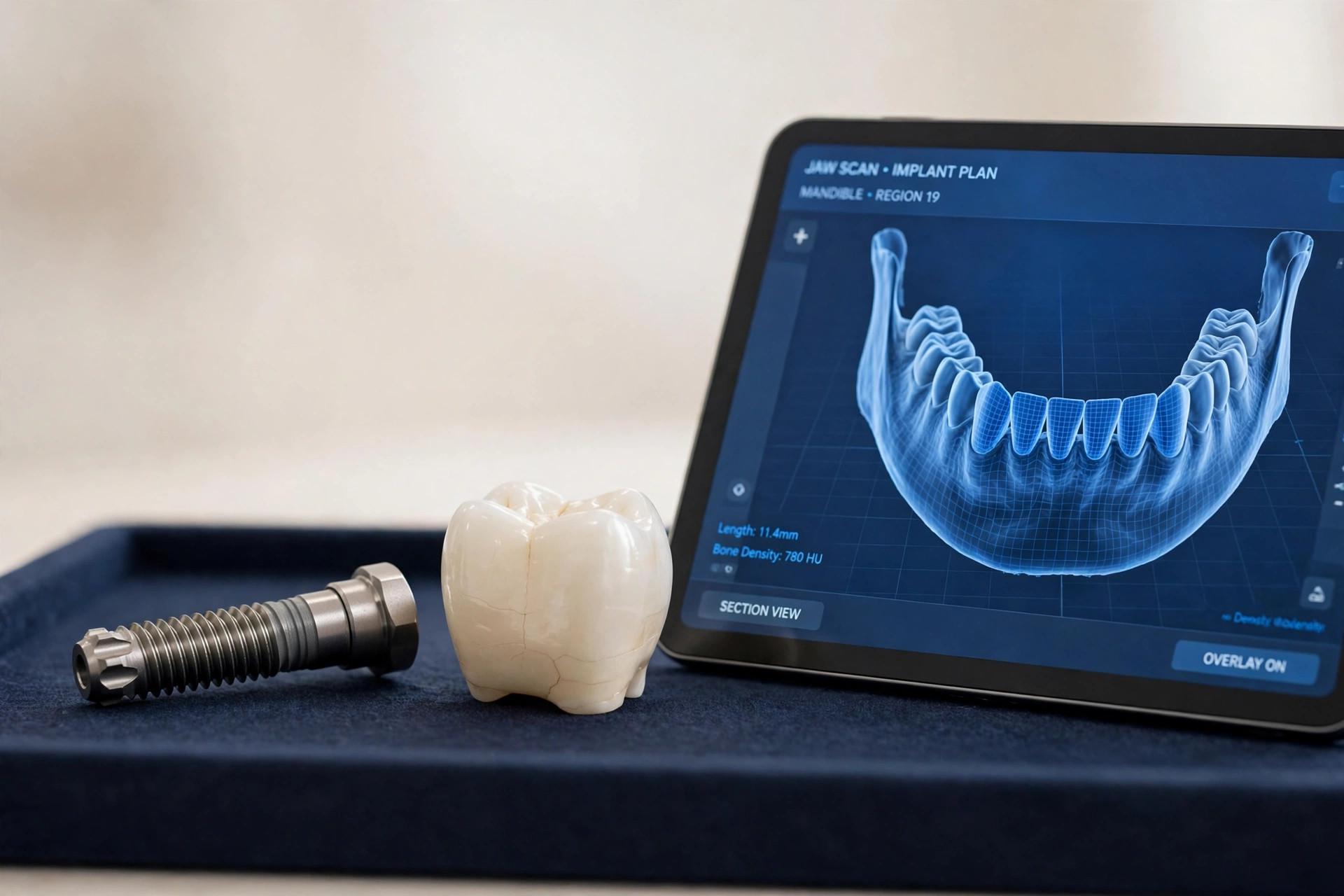
Bone grafting is the line item implant shoppers understand least — and the one that most often separates a low headline price from a complete quote. An implant is only as strong as the bone holding it, and jaws change after teeth are lost. This guide covers why grafting exists, what it costs in Dallas–Fort Worth, how much time it adds, and the questions that keep it honest in a written quote.
Why jaws lose bone
The bone around a tooth root exists to hold that tooth, and the body maintains it in response to the work it does. When a tooth comes out, that section of jaw no longer carries load, and it slowly resorbs — narrower and lower year by year. A tooth lost a decade ago usually leaves a thinner site than one lost last spring.
Gum disease and infection accelerate the loss, and a failing tooth can take bone with it before it is removed. This is why two patients quoted for the same single implant can face different plans: one has a full ridge of bone waiting, and the other needs volume rebuilt first. Neither plan is wrong; they are answers to different scans.
What grafting actually is
A bone graft places material into the site where bone is missing, and your own bone grows into it over the following months until the volume is yours again. Grafts range from a small socket graft placed the day a tooth comes out — preserving the ridge while it heals — to larger ridge grafts and sinus lifts that rebuild room for implants in the upper back jaw.
- Socket preservation — graft material placed in an extraction socket to hold the ridge’s shape while it heals.
- Ridge grafting — rebuilding width or height along a section of jaw where several teeth are missing.
- Sinus lift — adding bone below the sinus in the upper back jaw, where the sinus sits close to the tooth roots and leaves little height.
What grafting costs in DFW
Published Dallas–Fort Worth figures put grafting at $300–$3,000 depending on volume. The spread is wide because the word covers very different amounts of work: a small socket graft is a minor addition to an extraction appointment, while a sinus lift is its own surgical procedure.
| Where grafting appears | Published DFW figure | What it covers |
|---|---|---|
| Grafting, per site | $300–$3,000 | From a small socket graft to a larger ridge or sinus procedure |
| Extraction, per tooth | $150–$400 | Removing a tooth that cannot be saved |
| 3D CBCT scan | $0–$300 | Free at most DFW implant centers; the scan that shows whether grafting is needed |
| Complete single implant | $1,800–$5,000 | Fixture, abutment and crown across published metro prices |
Compiled November 2026 from published Dallas–Fort Worth provider pricing and this site’s DFW cost research. Prices change; the written quote from your consultation governs.
How much time grafting adds
Time is grafting’s second cost. A socket graft heals while the site rests anyway, so it may add nothing to the calendar. A larger graft is usually given several months to mature before an implant is placed into it, and that healing is the most common reason a single-implant case runs longer than the usual 3–6 months from placement to crown.
Some grafts are placed at the same surgery as the implant, when the implant can still be anchored firmly in your existing bone and the graft fills around it. Whether that is sound in your case is a scan question — the practice should show you the bone it is counting on, not just name the plan.
When grafting can be worked around
Full-arch treatment often avoids grafting by design: angled back implants anchor in the denser bone toward the front of the jaw, which is the core idea behind same-day full-arch treatment. Shorter and narrower implants also fit some single sites that a standard implant would not.
Workarounds have limits, and a trustworthy quote names them. If the bone is too thin in every direction, placing without grafting trades a few months of healing for a weaker foundation under years of bite force. The better question is not how to avoid grafting at any cost, but what your scan shows and what each route commits you to in money, months and strength.
Keeping grafting honest in your quote
- Ask to see the scan and the exact site the graft is for.
- Ask whether the graft heals first, or is placed with the implant — and what that does to your timeline.
- Confirm the graft’s price is inside the written quote, not a possible extra discovered later.
- Ask what happens to the price if the graft heals larger or smaller than expected.
The grafting bottom line
Grafting is foundation work: unglamorous, sometimes necessary, and priced honestly when it appears in the first written quote with its timeline attached. In DFW that figure runs $300–$3,000 by volume. Our form starts with the scan that answers it: five questions, one local practice, a consultation, and an exact written quote that includes the foundation your case actually needs.
Common questions
How much does bone grafting cost in Dallas–Fort Worth?
Published metro figures put bone grafting at $300–$3,000 depending on the volume of bone needed — a small graft at a single socket sits at the low end, and larger ridge or sinus grafts at the high end. Your 3D scan shows which case you are, and the graft belongs in the written quote from the start.
Why do implants need bone at all?
An implant holds because jawbone grows onto its surface and locks it in place. It needs enough height and width of bone around it to stay strong under bite force. After a tooth is lost, the bone that held it slowly shrinks — grafting rebuilds that volume before or during placement.
How long does grafting add to treatment?
A small graft placed with an extraction or at implant surgery may add little time. A larger graft usually heals for several months before the implant goes in, which is the most common reason a single-implant timeline runs past the usual 3–6 months.
Can grafting be avoided?
Sometimes. Angled placement in full-arch treatment often uses the denser bone toward the front of the jaw and avoids grafting at the back. Shorter or narrower implants fit some sites. Where the bone loss is advanced, though, grafting is the honest route — ask what your scan shows and what each option commits you to.
Skip the guessing. Get the exact number.
Five questions, one local practice, one exact written quote — implant, abutment, crown and fees, in writing, at a free consultation.
Reveal My Estimate →