Dental Implant Bridge: Cost for Replacing Several Teeth in a Row
Too many teeth for one implant, too few for a full arch — the implant bridge fills the middle. What it costs in 2026, how it compares with the options on either side, and how treatment runs.
Get an exact price for your implants.
A few quick questions, and one local practice sends you a written quote.
Five quick questions. Your answers go to one implant practice in your area — and your estimate comes back as an exact written quote from that practice, not a made-up range.
How this works
- Answer five questions — they tell the practice whether you need one implant or a full arch before anyone picks up a phone.
- One local practice gets your request. Not a marketplace, not a bidding list — one practice in your area.
- You get an exact written quote at a free consultation — implant, abutment, crown and fees in writing, before you decide anything.
Why no instant price?
Calculator sites invent a range from your clicks. We don't. The same mouth can price thousands apart depending on bone, extractions and the teeth you choose — so your estimate is a real quote from the practice that will do the work, with a 3D scan behind it. That is the number you can actually plan on.
Free · No obligation · We never sell your information. Your request goes to one local implant practice only.
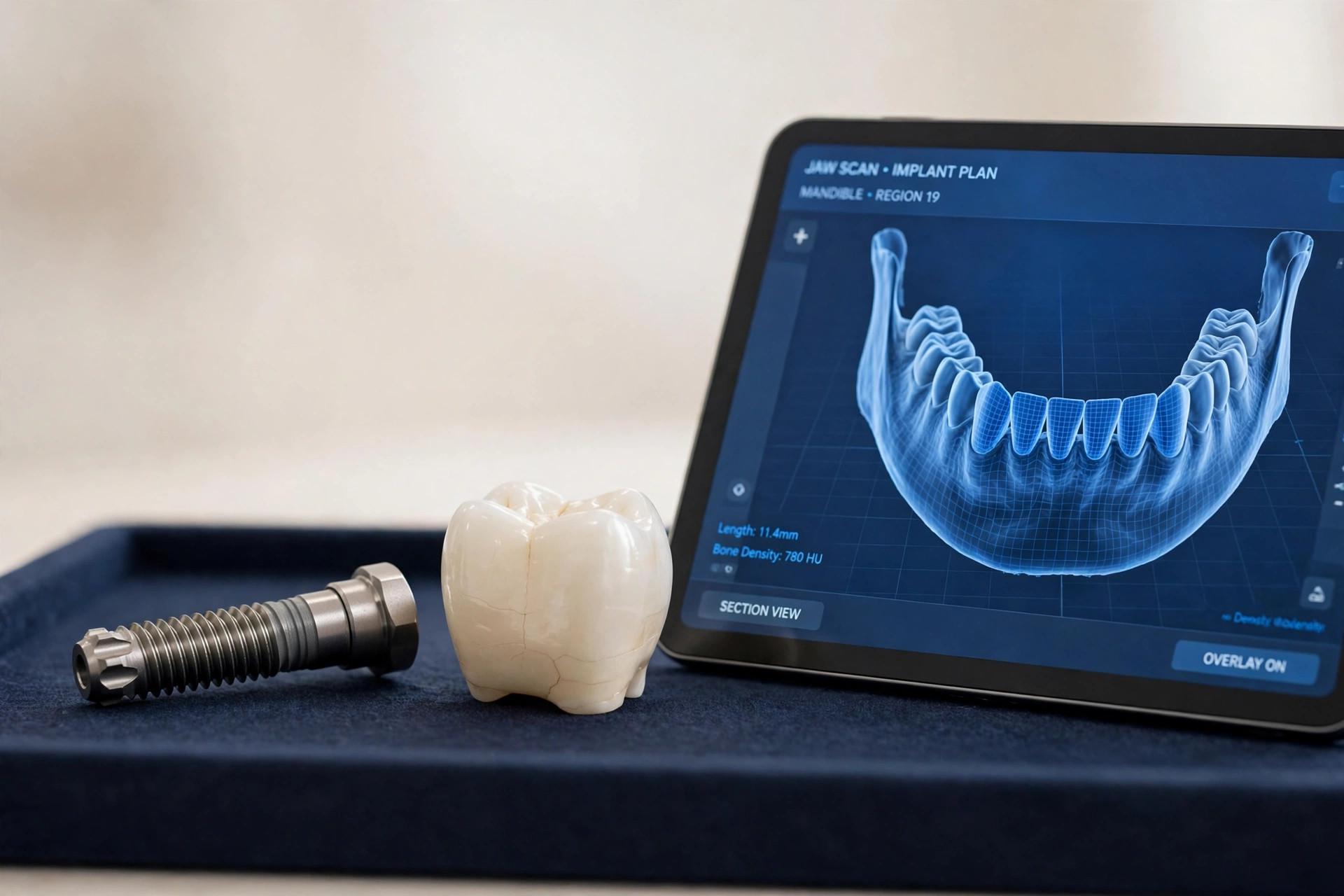
Missing two, three or four teeth in a row puts you between the familiar options: too many gaps for a single implant, far too few for a full arch. The implant bridge fills that middle — a row of connected replacement teeth carried by implants at each end. This guide covers what an implant bridge costs in 2026, how it compares with the alternatives on either side of it, and how the treatment runs.
What an implant bridge is
A typical implant bridge uses two implants to carry three or four teeth. The implants are placed under the two ends of the gap, and the restoration — one connected piece — carries a tooth over each implant plus one or two suspended teeth between them. Longer spans may use three implants; the span, your bone and your bite decide the count.
Because the bridge is anchored in the jaw, the natural teeth on either side of the gap are left completely alone. That is its structural difference from a conventional bridge, which is cemented to the neighboring teeth after they have been ground into posts to hold it.
What an implant bridge costs
| Treatment | Published DFW range | Typical US range |
|---|---|---|
| Implant bridge (2 implants, 3–4 teeth) | $6,000–$12,000 | $8,000–$16,000 |
| Single implant, complete (fixture + abutment + crown) | $1,800–$5,000 | $3,000–$6,000 |
| Fixed full arch, per arch (All-on-4 style) | $12,000–$25,000 | $14,000–$36,000 |
Compiled November 2026 from published provider pricing, including Dallas–Fort Worth practices and national published ranges. Prices change; the written quote from your consultation governs.
The math that makes the bridge attractive is simple: replacing three teeth with three individual implants means three fixtures, three abutments and three crowns. The bridge replaces the same three teeth with two fixtures and one restoration. You pay for fewer parts and fewer placements, and the teeth arrive as one fitted unit.
Implant bridge vs one implant per tooth
Individual implants remain the right answer where teeth are missing in separate places, or where a span is too long for two supports. For a single row of missing teeth, though, one implant per tooth buys strength you may not need at a price you definitely pay.
There is also a cleaning consideration that runs in the bridge’s favor and against it at once. A bridge is one unit to fit and adjust, and its underside needs a cleaning routine your practice will teach you — floss threaders or a water flosser reach under the suspended teeth. Individual crowns clean like natural teeth but cost more up front. Neither point decides alone; both belong in the conversation.
Implant bridge vs a conventional bridge
A conventional bridge costs less at the start and needs no surgery or healing months. Its costs arrive differently: the neighboring teeth must be reshaped to carry it, which commits two healthy teeth to crowns for life, and nothing replaces the missing roots, so the bone under the gap continues to shrink over the years.
The implant bridge asks for surgery and healing time up front, and in return it leaves the neighboring teeth untouched and keeps bite load on the bone through the implants. Pooled studies put about 95 of 100 implants still in place at ten years. Over a long horizon, that is the comparison most patients are really making: a lower first price with healthy teeth committed, or a higher first price that stands on its own anchors.
How the treatment runs
The sequence follows the standard implant process. A consultation with a 3D scan maps the bone along the whole span and confirms two sound positions for the implants. Any failing teeth in the row come out first — sometimes with the implants placed the same day, sometimes after healing, with grafting ($300–$3,000 by volume) where bone has thinned.
Placement is one surgery for both implants in most cases. Healing runs about 3–6 months while the implants fuse, often with a temporary solution over the gap where it shows. The lab then builds the bridge — porcelain or zirconia over its span — and it is fitted, adjusted for bite, and fixed to the implants at the final visits.
What to ask before you sign
- How many implants carry my span, and what did the scan show about the positions?
- Is the quote complete — fixtures, abutments, the bridge itself, extractions and any grafting?
- What is the bridge made of, and how is it cleaned and maintained?
- What does the warranty cover on the implants and on the bridge, and for how long?
The implant bridge bottom line
For a row of missing teeth, the implant bridge is usually the most economical implant answer per tooth replaced: $8,000–$16,000 at typical US prices for two implants carrying three or four teeth. It stands on its own anchors, spares the neighboring teeth, and follows a timeline you can plan around. Our form starts it: five questions, one local practice, a consultation with a scan, and an exact written quote for your span.
Common questions
How much does an implant bridge cost?
A bridge carried by two implants, replacing three or four teeth in a row, runs $8,000–$16,000 at typical US prices; published Dallas–Fort Worth prices run $6,000–$12,000. The exact figure turns on how many teeth the bridge carries, the material, and whether extractions or grafting are needed first.
Is an implant bridge cheaper than separate implants for each tooth?
Usually, yes. Three missing teeth in a row can be carried by two implants and a three-tooth bridge instead of three implants with three crowns — two fixtures and one connected restoration instead of three of everything. Your dentist confirms the span is sound for two supports.
How is an implant bridge different from a regular bridge?
A regular bridge is cemented onto the neighboring natural teeth, which must be ground down to hold it, and it replaces only the crowns — not the roots. An implant bridge is anchored in the jaw, leaves neighboring teeth untouched, and the implants keep load on the bone beneath.
How long does an implant bridge take?
The timeline follows the implants: placement, about 3–6 months of healing while the implants fuse with the bone, then impressions and fitting of the bridge. Preparatory work such as extractions or grafting can add months before placement.
Skip the guessing. Get the exact number.
Five questions, one local practice, one exact written quote — implant, abutment, crown and fees, in writing, at a free consultation.
Reveal My Estimate →