The Dental Implant Process: Steps, Timeline & What Healing Actually Takes
Implant treatment is a sequence, not a single appointment — and most of the timeline is healing, not chair time. The six steps, what each one involves, and how long the whole process runs.
Get an exact price for your implants.
A few quick questions, and one local practice sends you a written quote.
Five quick questions. Your answers go to one implant practice in your area — and your estimate comes back as an exact written quote from that practice, not a made-up range.
How this works
- Answer five questions — they tell the practice whether you need one implant or a full arch before anyone picks up a phone.
- One local practice gets your request. Not a marketplace, not a bidding list — one practice in your area.
- You get an exact written quote at a free consultation — implant, abutment, crown and fees in writing, before you decide anything.
Why no instant price?
Calculator sites invent a range from your clicks. We don't. The same mouth can price thousands apart depending on bone, extractions and the teeth you choose — so your estimate is a real quote from the practice that will do the work, with a 3D scan behind it. That is the number you can actually plan on.
Free · No obligation · We never sell your information. Your request goes to one local implant practice only.
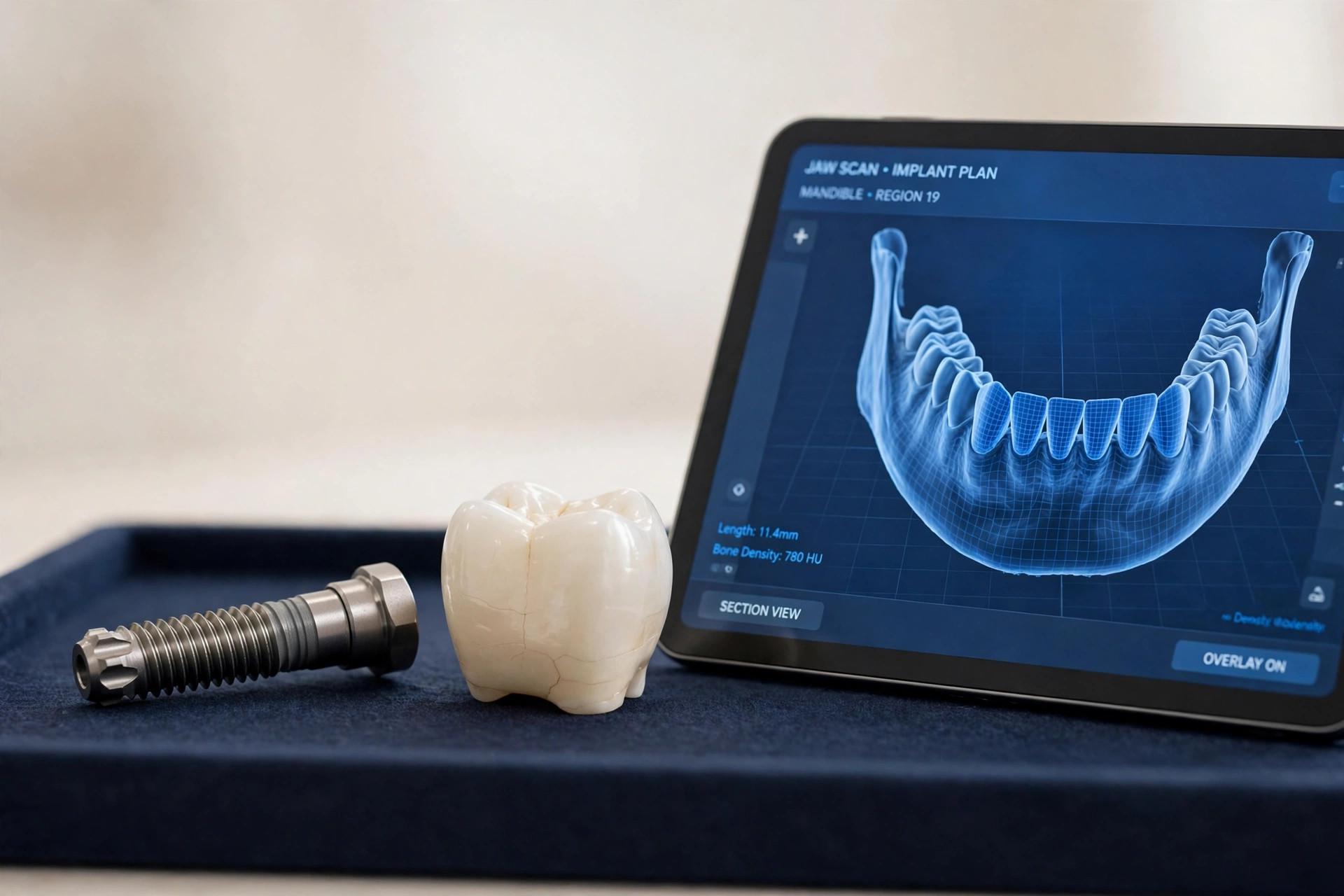
Dental implant treatment is a sequence, not a single appointment — and most of the timeline is healing, not chair time. Knowing the steps in advance removes most of the anxiety around the process and explains the prices you will be quoted: a complete single implant runs $3,000–$6,000 nationally, and a fixed full arch $12,000–$36,000 per arch at published chain prices, with many independent practices publishing $12,000–$25,000 per arch. Here is how treatment unfolds, step by step.
Step 1: Consultation, records and the 3D scan
Treatment starts with an examination and a 3D CBCT scan. The scan shows bone height and width, the position of nerves and sinuses, and whether teeth still present can be kept. It is the scan that turns a price range into an exact written quote.
At the same visit the practice reviews your health history and medications, because healing is part of the treatment. Smoking, uncontrolled blood sugar and certain medications change the plan or its timing. An honest consultation names those factors plainly rather than discovering them mid-treatment.
Step 2: The treatment plan, in writing
- What is being replaced — one tooth, several teeth, a full arch or both arches.
- The preparatory steps — extractions or grafting, if your bone needs them, and the healing each one adds.
- The parts and their prices — implant, abutment and crown for a single tooth; implants, temporaries and final teeth for an arch.
- The timeline — surgery date, healing period and when final teeth are expected.
Step 3: Preparatory work, when it is needed
Not every case needs it. A tooth that must come out can sometimes receive an implant the same day; in other cases the site heals first. Where the jaw has thinned after years without a tooth, bone grafting rebuilds the volume an implant needs to hold.
Grafting is the step that most often extends a timeline, adding months of healing before placement. It is also the step a cheap headline price most often leaves out. If your plan includes grafting, its cost and its months belong in the written quote from the start.
Step 4: Placement surgery
The implant — a titanium post — is placed into the jaw under local anesthesia, with sedation offered by many practices for patients who prefer it. For a single implant the appointment is commonly under an hour of surgery. For a full arch, remaining teeth planned for removal come out and four to six implants per arch go in at the same visit.
Full-arch patients usually leave with fixed temporary teeth attached that day. Single-implant patients usually leave with the site closed or with a small healing cap, and a temporary tooth solution only where the gap shows. The difference is normal: an arch of temporaries can be braced across several implants at once, while one new implant should not carry full bite force yet.
Step 5: Healing and fusion
Over the following months the bone grows onto the implant surface and locks it in place — the process called osseointegration. It cannot be rushed, and it is why the full timeline runs 3–6 months for a single implant and about 4–6 months before final full-arch teeth. Pooled studies put about 95 of 100 implants still in place at ten years, and careful healing is part of how that record is earned.
Life during healing is mostly ordinary: a softer diet at first, careful cleaning around the site, and short check visits. Full-arch patients wear their fixed temporaries throughout. Pain and swelling belong to the first days, not the whole period, and the practice should tell you exactly what to expect and what to report.
One tooth vs a full arch: where the steps differ
The sequence is the same, but two steps change character with the size of the case. Placement for one implant is a short, single-site surgery, and the healing site is easy to keep clean and unloaded. Placement for a full arch is a longer appointment — extractions and several implants in one plan — and the fixed temporaries fitted that day spread bite force across all the new implants together, which is what makes same-day teeth possible at all.
The final step differs too. A single crown is one tooth, fitted once. A final arch is a full set of teeth whose bite must balance across both jaws, so practices build in try-in and adjustment visits before the result is finished. When you compare timelines or quotes, compare them within the same case size — a single-tooth timeline tells you little about an arch, and the reverse is also true.
Step 6: Final teeth and the years after
Once fusion is confirmed, the practice scans or takes impressions and the lab builds the final crown or arch. Final teeth are fitted, the bite is adjusted, and you leave with the result the whole sequence aimed at. For full arches, zirconia is the longer-wearing final material most premium quotes include; acrylic arches need major refurbishment sooner.
Aftercare is part of the process, not an extra: hygiene visits two or more times a year, daily cleaning around and under the teeth, and a night guard if you grind. The crown or arch on top will need service before the implants beneath it do. Our form starts step one: five questions, one local practice, a free consultation with the scan that makes your own timeline and exact price knowable.
Common questions
How long does the whole implant process take?
A single implant usually takes 3–6 months from placement to the final crown, because the implant needs time to fuse with the bone before it carries full bite force. Full-arch treatment gives fixed temporary teeth on surgery day, with final teeth after about 4–6 months of healing.
Does getting an implant involve several surgeries?
Usually one main surgery places the implant. Some cases add a step before it — an extraction that must heal first, or bone grafting where the jaw is thin — and grafting can add months. The 3D scan at consultation shows whether your case needs those steps.
What is the healing period actually like?
The first days involve swelling and a softer diet; most patients return to desk work within a few days. The longer healing that follows is quiet — the implant fuses below the gum while you live normally — with check visits so the practice can confirm progress before the final tooth is made.
When do I get my final tooth?
After the implant has fused, the practice takes impressions or digital scans and the lab makes the crown or arch. A single crown is fitted and adjusted at a final visit; a full arch is set precisely over follow-up visits once healing is complete.
Skip the guessing. Get the exact number.
Five questions, one local practice, one exact written quote — implant, abutment, crown and fees, in writing, at a free consultation.
Reveal My Estimate →