Tooth Extraction Cost Before Implants in Dallas–Fort Worth
Implant plans that replace failing teeth start with taking the old teeth out — a line with published DFW fees of its own. What simple and surgical extractions cost here, and how they land inside an implant quote.
Get an exact price for your implants.
A few quick questions, and one local practice sends you a written quote.
Five quick questions. Your answers go to one implant practice in your area — and your estimate comes back as an exact written quote from that practice, not a made-up range.
How this works
- Answer five questions — they tell the practice whether you need one implant or a full arch before anyone picks up a phone.
- One local practice gets your request. Not a marketplace, not a bidding list — one practice in your area.
- You get an exact written quote at a free consultation — implant, abutment, crown and fees in writing, before you decide anything.
Why no instant price?
Calculator sites invent a range from your clicks. We don't. The same mouth can price thousands apart depending on bone, extractions and the teeth you choose — so your estimate is a real quote from the practice that will do the work, with a 3D scan behind it. That is the number you can actually plan on.
Free · No obligation · We never sell your information. Your request goes to one local implant practice only.
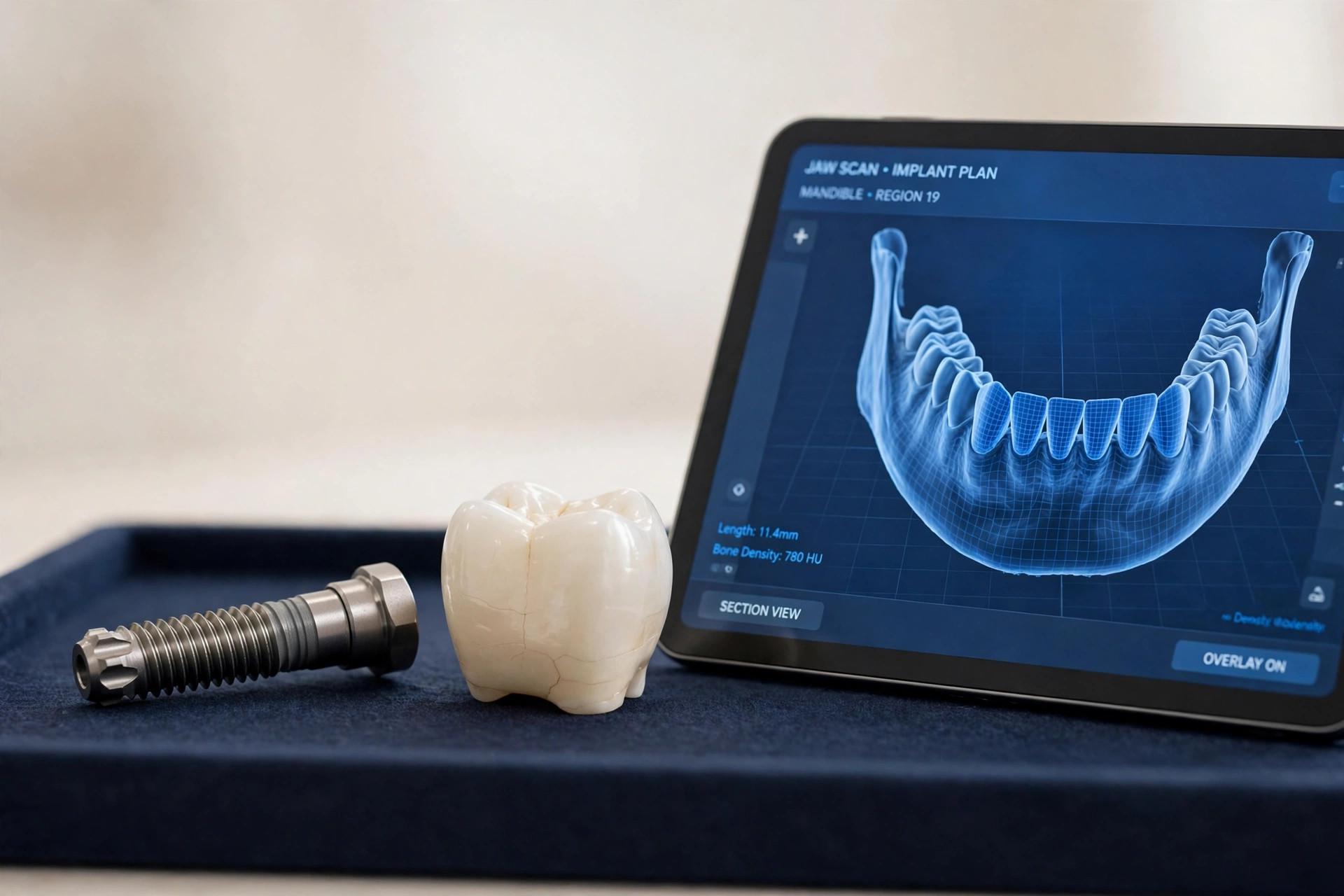
Almost every implant plan that replaces failing teeth starts with a line patients rarely budget for: taking the old teeth out. In Dallas–Fort Worth the extraction line is published by area practices in the open, so it can be planned instead of discovered. This guide sets out what extractions cost here, why the fee splits in two, and how the line interacts with the implant quote that follows it.
Published extraction fees in the metro
| Extraction type | Published DFW-area fees | Published by |
|---|---|---|
| Simple extraction, per tooth | $150–$300 | Frisco practice (published range) |
| Simple extraction, per tooth | $357 standard fee | Frisco practice (published fee schedule) |
| Surgical extraction, per tooth | $225–$600 | Frisco practice (published range) |
| Surgical extraction, per tooth | $495 standard fee | Frisco practice (published fee schedule) |
Published provider pricing pulled November 2026 from the practices' own pages: Coit Dental (Frisco) and Highland Oak Dental (Frisco). One schedule publishes a lower member-plan price beside its standard fee, as Texas advertising rules require when a discount is shown; the standard fees above are the figures that compare with other practices' ranges. Fees change; your written quote governs.
Why there are two prices for taking a tooth out
A simple extraction is a tooth that shows above the gum, is loosened with instruments, and lifts out whole. It is minutes of work under local anesthetic, and it is priced like it. A surgical extraction is the other kind of tooth: broken off at the gum line, tipped or impacted under the gum or bone, or rooted in a way that will not release in one piece.
The surgical version takes an incision, sometimes a small amount of bone removed, and sometimes the tooth sectioned into pieces that each come out cleanly. More time, more technique, more aftercare — the published gap between roughly $150–$357 simple and $225–$600 surgical is that difference, priced. Wisdom teeth are usually quoted on the surgical line, and per tooth.
How extractions land inside an implant budget
Three patterns cover most DFW cases. For a single implant replacing one failing tooth, the extraction is a separate line ahead of the implant fee, typically at the simple or surgical rate above depending on the tooth's condition. For a full arch, some metro practices publish arch prices that include the extractions needed on surgery day — the failing teeth come out and the implants go in at the same visit — while others quote the removals separately, so a full-mouth clearance can add several per-tooth fees to the arch price.
The third pattern is timing. An implant cannot always be placed the day a tooth comes out; a socket that needs to heal, or to be grafted and mature, adds months before placement. That is a schedule cost rather than a fee, but it belongs in the same conversation, because it decides when the final teeth arrive.
The line that travels with extractions: socket preservation
When a tooth comes out, the socket begins to shrink — the bone that held the root has lost its job. If an implant is planned for that exact spot, practices can pack the socket with graft material at the extraction visit to hold its volume. Published Texas pricing for a graft at extraction runs a few hundred dollars per site (a Houston oral surgery practice publishes $250–$1,200 depending on the socket), and larger grafting in DFW publishes at $300–$3,000 by volume in our grafting guide.
Preserving a socket you intend to use is almost always the smaller spend. Rebuilding a ridge that collapsed a year later is the larger graft, with its own healing months. If your plan includes implants, ask at the extraction quote — not after — whether preservation belongs in your case.
Sedation is priced per visit, not per tooth
Local anesthetic is ordinarily part of the extraction fee. Anything beyond it — nitrous oxide, oral sedation, IV sedation — is a separate line, and the published pattern is one charge for the appointment rather than a charge multiplied by teeth. For a multi-tooth clearance that distinction matters: four surgical extractions under one sedation fee is a different budget from four sedation fees.
Before the day, or on the day?
Extractions land in an implant plan at one of two moments. In an immediate plan, the failing tooth comes out and the implant goes into the same socket at the same visit — one surgery, one healing period, and the extraction fee and placement fee in a single treatment plan. In a staged plan, the tooth comes out first, the socket heals or is grafted and given months to mature, and placement follows. Staged treatment is not a lesser plan: infected sites, thin bone and multi-tooth clearances often stage deliberately, because placing into a clean, mature site is the more predictable surgery.
Which moment fits is a clinical judgment made from the scan, and it changes the fee picture only modestly — the same extractions at the same published per-tooth rates — but it changes the calendar a great deal. When a quote proposes staging, ask what the interval buys: graft maturation, infection resolution, or bone recovery are concrete answers; a vague delay is worth a second opinion.
Insurance and the extraction line
Extractions are among the more commonly covered lines in dental plans — plans that treat implants as a major service, or exclude them, still commonly cover medically necessary removals as a standard benefit, subject to the deductible and the plan's annual maximum. That asymmetry is worth using: the removal year and the implant year can be sequenced so the covered line is claimed in the year it occurs, rather than bundled into a year where the maximum is already spent. Our insurance guide works through the annual-maximum arithmetic for DFW in full.
The bottom line
Budget the extraction line before the implant line: roughly $150–$357 per tooth for simple removals and $225–$600 for surgical ones at published DFW-area fees, plus socket preservation where an implant will follow, plus one sedation line if you want it. Then make the implant quote say, in writing, which of those lines it includes. Our form starts that process: five questions, one local practice, and an exact written quote that lists the whole plan — extractions included or itemized, nothing assumed.
Common questions
How much does a tooth extraction cost in Dallas–Fort Worth?
Published DFW-area fees: a Frisco practice publishes simple extractions at $150–$300 per tooth and surgical extractions at $225–$600 per tooth. Another Frisco practice publishes standard fees of $357 for a simple extraction and $495 for a surgical extraction. Where your tooth sits — erupted and whole, or broken and impacted — decides which line applies.
Is the extraction included in an implant quote?
Sometimes. Some full-arch prices published in the metro state that extractions needed on surgery day are included in the arch price; a single-implant quote more often lists extractions as their own line. The only safe answer is the written quote: check whether extraction appears as a line, as included, or not at all.
What is the difference between a simple and a surgical extraction?
A simple extraction removes a tooth that is visible above the gum and comes out whole with instruments. A surgical extraction is for a tooth broken at the gum line, impacted under gum or bone, or with roots that cannot come out in one piece — it takes an incision, sometimes bone removal, and more time, which is why it is priced higher.
Should the socket be grafted when the tooth comes out?
If an implant is planned for that spot, preserving the socket with graft material at extraction time keeps bone volume the implant will need later. It is a separate line item with its own fee, and it is far cheaper to preserve bone at extraction than to rebuild it months later. Your implant plan, not the extraction itself, decides whether it belongs in your case.
Skip the guessing. Get the exact number.
Five questions, one local practice, one exact written quote — implant, abutment, crown and fees, in writing, at a free consultation.
Reveal My Estimate →