How Long Do Dental Implants Last? What the Long-Term Studies Show
Not “a lifetime” — something better documented than that: about 95 of 100 implants still in place at ten years in pooled research. Survival vs success, what wears first, and what you control.
Get an exact price for your implants.
A few quick questions, and one local practice sends you a written quote.
Five quick questions. Your answers go to one implant practice in your area — and your estimate comes back as an exact written quote from that practice, not a made-up range.
How this works
- Answer five questions — they tell the practice whether you need one implant or a full arch before anyone picks up a phone.
- One local practice gets your request. Not a marketplace, not a bidding list — one practice in your area.
- You get an exact written quote at a free consultation — implant, abutment, crown and fees in writing, before you decide anything.
Why no instant price?
Calculator sites invent a range from your clicks. We don't. The same mouth can price thousands apart depending on bone, extractions and the teeth you choose — so your estimate is a real quote from the practice that will do the work, with a 3D scan behind it. That is the number you can actually plan on.
Free · No obligation · We never sell your information. Your request goes to one local implant practice only.
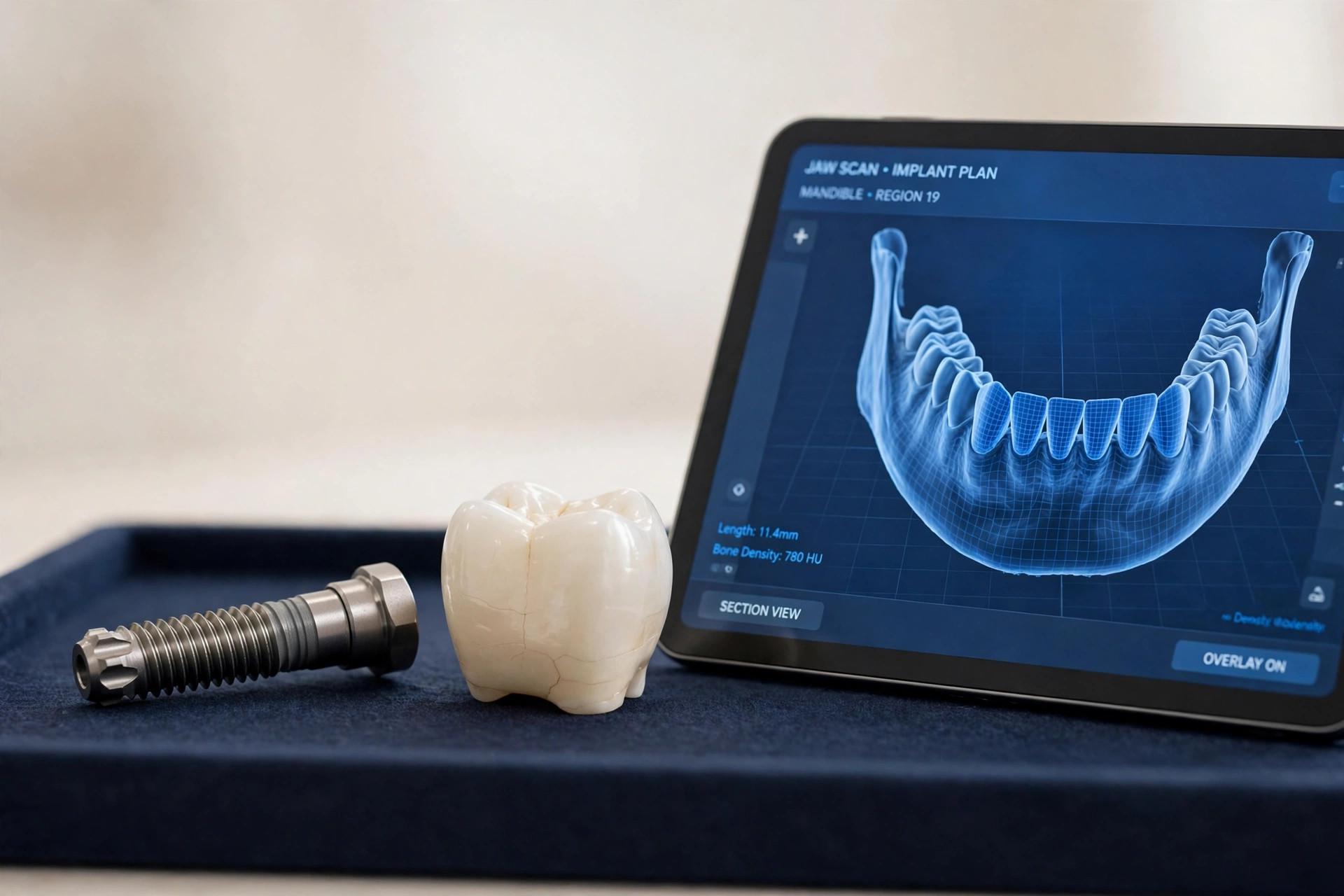
Ask how long dental implants last and you will hear two kinds of answer: marketing (“a lifetime!”) and the research. This guide prints the research. Implants do have the longest service life of any tooth replacement — the pooled evidence supports that plainly. It also shows exactly where the limits are: what survives, what wears, and what you control.
First, two words that are not the same: survival and success
Studies report implants two ways, and confusing them inflates almost every claim you will read. Survival means the implant is still in place. Success is stricter — the implant in place and healthy: no significant bone loss, no persistent inflammation, working as intended. Survival runs high. Success, measured strictly, runs lower, because an implant can be present and still have problems around it.
- 10-year survival: about 95–96 of 100 implants still in place — 96.4% across 23 studies and 7,711 implants in one pooled analysis (Howe et al., Journal of Dentistry, 2019), and roughly 95% in a larger recent meta-analysis covering 20,445 implants.
- Success averages lower — about 85% in the studies that measured it strictly, with definitions varying between studies.
- 20-year survival: around 9 in 10 in the longest pooled follow-ups (about 90% at twenty years in published meta-analysis).
Sources: Howe, Keys & Richards, Journal of Dentistry (2019); Periodontology 2000 meta-analysis of 34 studies / 20,445 implants; Moraschini et al., International Journal of Oral and Maxillofacial Surgery (2015). Figures are pooled across implant systems and patient groups — your own risk factors move your personal odds, in both directions.
So what actually ends an implant's service?
Four things account for most implant losses and most of the maintenance in between:
- Peri-implant disease. Inflammation around an implant — first the gum (mucositis), then the supporting bone (peri-implantitis) — is the main biological threat. Pooled data puts peri-implantitis at roughly one implant in ten on average, with wide variation between studies. It is driven by plaque and by history of gum disease, and it is the reason implant patients are kept on a closer cleaning schedule.
- Smoking. Meta-analysis across hundreds of studies puts smokers’ implant failure odds at roughly double those of non-smokers. It is the single largest controllable risk factor.
- Overload and grinding. Implants have no ligament to cushion bite force. Heavy grinding without a night guard stresses the fixture, the screws and the teeth above them.
- The restoration wearing out. Crowns chip and wear; full-arch acrylic teeth need major service in roughly 5–10 years (zirconia considerably longer); small parts — screws, attachments — occasionally need replacement. This is wear, not failure, and it is the normal cost of ownership.
The comparison that matters: service life per option
| Option | Typical service picture | Ownership notes |
|---|---|---|
| Single implant + crown | Implant ~95% in place at 10 years (pooled) | Crown may need replacement sooner; hygiene visits 2×+ a year |
| Fixed full arch (All-on-4 style) | Implants track the same pooled survival | Teeth on top are the service item — acrylic sooner, zirconia later |
| Traditional bridge | Commonly replaced in 10–15 years | Requires shaping the neighboring teeth; decay under a crown can end it early |
| Removable denture | Commonly replaced in 5–8 years | Relines and adhesives ongoing; the jawbone under it keeps shrinking |
That table is why the cost math favors implants over time despite the higher first price: at published prices ($3,000–$6,000 for a complete single implant nationally; $1,800–$3,000 at high-volume Dallas–Fort Worth practices), an implant that serves twenty years costs less per year than replacements that cycle twice in the same span. Per-year math is not the only reason to choose implants — bite strength and bone preservation count too — but it answers the “are they worth it” question in the terms the research supports.
What you control: the habits that protect the result
- Keep the recall schedule. Professional hygiene visits two to four times a year for implant patients, with checks of the tissue and bone around each implant.
- Clean under and around daily. A water flosser and interdental brushes reach where a toothbrush cannot, especially under a full arch.
- Stop smoking before surgery — the clearest move any patient can make for their own odds.
- Wear the night guard if you grind; it is cheap insurance for a five-figure restoration.
- Report changes early. Bleeding, looseness or a new ache around an implant is far easier to treat in month one than year two.
The honest bottom line
No practice can promise your implant a lifetime, and you should be wary of one that does — outcomes are never guaranteed, in dentistry or anywhere else in medicine. What the evidence does support is this: implants are the longest-lasting tooth replacement available, with about 95 of 100 still in place at ten years across pooled studies, and the biggest influences on whether yours reaches the long end of that record are a careful placement, honest maintenance, and not smoking. If you want your own picture — your bone, your risk factors, your exact price — it starts with an exam and a 3D scan. Our form arranges exactly that: five questions, one local practice, a written quote, no obligation.
Common questions
Do dental implants last forever?
No honest answer promises forever — no study follows implants for a lifetime. What the long-term research shows is strong: in pooled studies, about 95 of 100 implants are still in place at ten years, and around 9 in 10 at twenty years in longer-running data. That is a long service life, and it is not a guarantee for any individual implant.
What usually wears out first — the implant or the tooth on top?
Usually the restoration, not the implant. Crowns can chip, wear or need replacement on a shorter cycle than the fixture beneath them, and full-arch teeth need periodic service — acrylic arches commonly need major refurbishment in 5–10 years, zirconia lasts considerably longer. Budget for maintaining the teeth, not just placing the implants.
What shortens an implant's life?
Smoking is the clearest factor — pooled research puts implant failure odds for smokers at roughly double those of non-smokers. Gum inflammation around an implant (peri-implantitis) affects a substantial minority of implants over time and is the main biological threat, which is why hygiene visits matter. Uncontrolled diabetes, heavy teeth-grinding without a guard, and skipped maintenance all raise risk.
How long does All-on-4 last?
The implants under a full arch show the same high long-term survival as single implants in pooled research, when maintenance happens. The arch of teeth on top is the service item: temporaries last the healing period, acrylic finals need refurbishment sooner, zirconia finals are the longer-wearing standard. Ask any center what year-five maintenance typically costs its patients — the answer tells you how the practice thinks about the long term.
Skip the guessing. Get the exact number.
Five questions, one local practice, one exact written quote — implant, abutment, crown and fees, in writing, at a free consultation.
Reveal My Estimate →