Titanium vs Zirconia Dental Implants
Two post materials, one job — and very different lengths of track record. What the systematic reviews report on survival, bone response, aesthetics and fracture, and where each material fits.
Get an exact price for your implants.
A few quick questions, and one local practice sends you a written quote.
Five quick questions. Your answers go to one implant practice in your area — and your estimate comes back as an exact written quote from that practice, not a made-up range.
How this works
- Answer five questions — they tell the practice whether you need one implant or a full arch before anyone picks up a phone.
- One local practice gets your request. Not a marketplace, not a bidding list — one practice in your area.
- You get an exact written quote at a free consultation — implant, abutment, crown and fees in writing, before you decide anything.
Why no instant price?
Calculator sites invent a range from your clicks. We don't. The same mouth can price thousands apart depending on bone, extractions and the teeth you choose — so your estimate is a real quote from the practice that will do the work, with a 3D scan behind it. That is the number you can actually plan on.
Free · No obligation · We never sell your information. Your request goes to one local implant practice only.
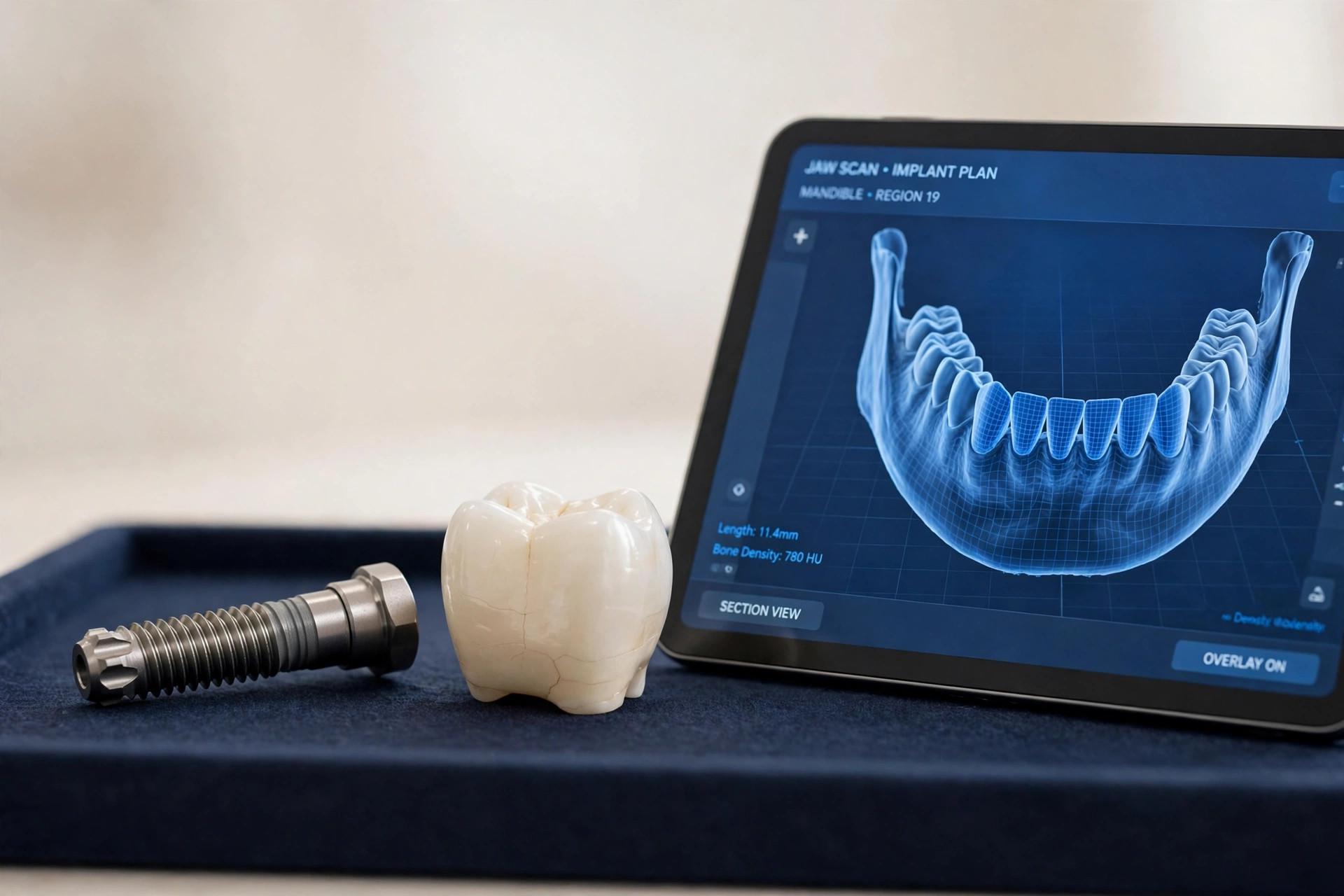
Almost every implant placed today is one of two materials: titanium, the metal the field was built on, or zirconia, a white ceramic that has moved from a niche alternative into ordinary practice catalogues. The marketing version of the choice is simple — metal versus metal-free. The published version is more useful: two materials with similar bone behaviour, different mechanical limits, and very different lengths of track record. This guide reads the comparison as the systematic reviews report it.
What each material actually is
Titanium implants are made from commercially pure titanium or from a titanium alloy — the common implant alloy is 90% titanium, 6% aluminum and 4% vanadium. The surface is treated so bone can grow against it, and the post forms a protective oxide layer in the body. Titanium dental implants have been used for over fifty years, which is why almost every long-term number in implant dentistry is, underneath, a titanium number.
Zirconia implants are made from zirconium dioxide, a ceramic — white, metal-free, and already fully oxidized, so there is no metal surface to corrode. The zirconia used for implants is stabilized with yttria to keep the ceramic strong. It is a genuinely different material from the zirconia used for crowns: here the ceramic itself is the post that goes into the bone and carries the load.
Survival: what the reviews report
An overview of systematic reviews — a review of reviews, covering systematic reviews published between 2014 and March 2023 — compared the two materials across survival, bone loss, probing depth, bleeding, plaque and aesthetic scores. Its findings: titanium implants showed survival rates of 92.6% to 100% across the pooled reviews, against 87.5% to 91.25% for zirconia, and the overview concluded that zirconia was associated with a greater risk of failure and lower overall success, while calling titanium the standard for long-term predictability and zirconia a viable alternative in aesthetically demanding cases.
Zirconia read on its own record looks better than that head-to-head range suggests. A systematic review and meta-analysis of zirconia implants alone pooled 25 clinical studies covering 4,017 zirconia implants in 2,083 patients and found a cumulative ten-year survival of 95.1%. Most failures in that pool happened early, within the first year, while bone was still growing onto the surface. The International Team for Implantology reports a five-year mean survival of about 97.2% for the zirconia implants in its review, while noting that the evidence primarily covers one-piece systems.
Direct head-to-head trials are still few. One 2023 systematic review found only two randomized trials that met its standards — 100 zirconia and 99 titanium implants, followed for 12 to 80 months — and in those trials survival did not differ significantly between the materials, while gum aesthetics scored higher around zirconia. Read together, the record says this: zirconia performs well in the studies that exist, titanium performs at least as well in the comparisons that exist, and titanium's record runs decades longer.
Bone and gum response
On the measures around the implant, the materials are close. The overview of reviews found marginal bone loss comparable between the two — reported ranges of about −1.17 to −0.125 mm for titanium and −1.38 to −0.25 mm for zirconia — and probing depths, plaque index and bleeding on probing in similar ranges as well. Zirconia showed greater early bone apposition at two weeks; titanium showed a more favourable bone response at four weeks. Neither material holds a decisive biological advantage in the pooled data.
The clearest difference is at the gumline. Zirconia is tooth-coloured, so it does not show a gray line through thin gum tissue the way a metal post can, and the aesthetic scores in the reviews favour it. That matters most where the implant sits in the visible zone under thin tissue — and matters very little for a back molar under thick tissue, where nobody sees the post at all.
The mechanical limit: fracture and design
Ceramic and metal fail differently. Titanium bends under extreme load before it breaks; zirconia, a ceramic, can fracture. Reviews of the anterior (front-tooth) evidence note that zirconia implants were more often associated with mechanical and technical complications, and several reviews flag a higher fracture risk for zirconia, especially in areas of high biting force. Narrow-diameter zirconia posts in back teeth are where that caution concentrates.
Design narrows the options further. The zirconia record is primarily a one-piece record — post and abutment in a single unit — which means the angle of the finished crown is set at placement and cannot be corrected with a separate angled abutment afterward. Titanium's two-piece systems offer a wide catalogue of components, including parts for implants placed decades ago. None of this disqualifies zirconia; it means the case has to fit the material, rather than the material adjusting to the case.
Where each material fits
- Titanium is the default record-holder: back teeth and high bite forces, full-arch work, angled placements that need component flexibility, and any case where the longest evidence matters most.
- Zirconia is the considered alternative: a front tooth under thin gums where a gray show-through would be visible, a patient who wants a metal-free post, and a site with favourable bone and load where a one-piece design fits the plan.
- Either way, the crown is a separate choice: the material of the post and the material of the visible tooth are different decisions, and a titanium post routinely carries a zirconia crown.
Questions to ask before you accept a material
Ask which system and material the quote assumes, and whether the practice places both or mainly one — a recommendation from a practice that offers only one material is a different kind of information than a choice between two. Ask what the long-term data behind the recommendation is, in years. And ask what happens in year ten if a component needs service: who stocks the parts, and are they still made. The material decision is one line of the treatment plan, but it is a line you live with for decades, and it deserves the same written-quote discipline as the price.
The bottom line
Titanium and zirconia implants both integrate with bone, and on bone loss and gum measures the pooled reviews find them close. Titanium carries the longer and, in head-to-head reviews, somewhat stronger survival record, plus unmatched component flexibility. Zirconia carries the aesthetic edge at the gumline and a metal-free post, with a ten-year pooled survival of 95.1% on its own record and a fracture caution in high-load sites. Choose with the evidence for your site — front or back, thick or thin tissue, simple or angled placement — and get the chosen system named in the written quote.
Sources pulled November 2026: Shetty et al., Comparative Evaluation of Titanium Versus Zirconia Implants for Their Clinical Outcomes: An Overview of Reviews, Cureus 2026 (systematic reviews 2014–March 2023); Mohseni et al., Clinical outcomes of zirconia implants: a systematic review and meta-analysis (25 studies, 4,017 implants); International Team for Implantology zirconia review summary (five-year mean survival about 97.2%, primarily one-piece systems); overview of systematic reviews on zirconia vs titanium in the anterior region (Springer). This page is general information about published research, not a recommendation for an individual case.
Common questions
Do zirconia implants last as long as titanium implants?
The pooled record is shorter and, in several reviews, a step behind. An overview of systematic reviews covering reviews published from 2014 to March 2023 reports survival ranges of 92.6% to 100% for titanium implants and 87.5% to 91.25% for zirconia implants across the reviews it pooled, with zirconia carrying a greater risk of failure. A separate systematic review of zirconia alone — 4,017 zirconia implants in 2,083 patients across 25 studies — found a ten-year cumulative survival of 95.1%, with most failures occurring early, in the first year. Titanium has been in clinical use for more than fifty years; zirconia has not, and no review can report a twenty- or thirty-year zirconia record that does not yet exist.
Why would anyone choose a zirconia implant?
Appearance at the gumline and a metal-free post. Zirconia is white, so where gum tissue is thin it does not show the gray shading a titanium post can show through the tissue. The overview of reviews also found zirconia scored better on aesthetic measures and showed greater early bone apposition at two weeks. For a front tooth under thin gums, or for a patient who wants no metal post, those are real reasons — weighed against a shorter evidence record.
What is the practical difference between one-piece and two-piece implants?
Most titanium implants are two pieces: the post in the bone and a separate abutment the crown attaches to, which lets the clinician correct angles and choose components for the site. Zirconia implants in the long-term data are primarily one-piece — post and abutment as a single unit — which the International Team for Implantology notes is the design its five-year zirconia survival figure of about 97.2% mainly reflects. A one-piece design leaves less room to adjust the crown's angle after placement, which is one reason case selection matters more with zirconia.
Does the implant material change the price?
It can, because the quote is built from the implant system, the components that fit it, and the lab work on top — and those differ by material. Published prices rarely break the material out as its own line, so the material's cost shows up inside the complete quote rather than on it. Ask for the quote itemized (post, abutment, crown) and ask which system and material each line assumes; that is the version you can compare against a second quote.
Skip the guessing. Get the exact number.
Five questions, one local practice, one exact written quote — implant, abutment, crown and fees, in writing, at a free consultation.
Reveal My Estimate →